
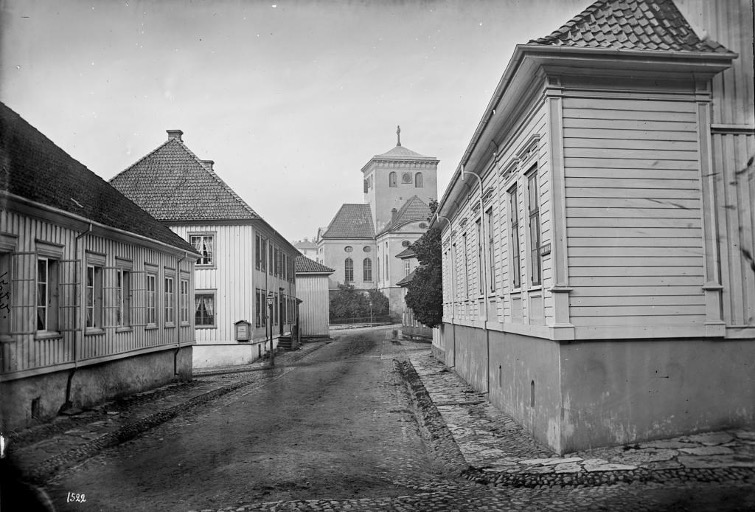
Løvestret with the church in the background. Number 27, Henrik Johan Ibsen's house in the foreground on the left. Then the house of the widow Rehbinder. She was the widow of Simon Jørgensen Wesseltoft and had married for the second time in 1797 to the originally Courland major Fredrik Rehbinder. The best men at that wedding had been both County Commissioner Adeler and her four-year-old brother, the later Eidsvollsmann Didrich von Cappelen Jr. In the same year, 1797, she had a son, Gustav Christian, before Major Rehbinder died the following year and she became a widow for the second time. In the census of 1801, she was stated to be living on her own means, which must clearly have been ample because she had both a housemaid and a housekeeper and 7 servants.
Although the main house at number 27 in Løvestredet only had one floor, it had 11 rooms with 10 tiled stoves and under the house there were three brick-built cellars and a brewhouse with a built-in brew kettle. In the backyard there was a boys' room with stables and barns and the property also had a sea shed with 9 rooms. In total, the property had a tax rate of 1960 riksdaler.
Henrik Johan and Johanne Cathrine first had a son, Jacob von der Lippe Ibsen, named after his father's stepfather, and on 3 October 1797, Knud Ibsen, named after his grandfather Knud Plesner. Just over a month later, on the night of 22 November 1797, Charitas was wrecked on Teinedypet outside Hesnes in Fjære parish near Grimstad.
Johanne Cathrine was remarried to skipper Ole Cornelius Paus from Lårdal in Øvre Telemark on 27 November 1798. This happened quickly and actually two weeks before the naval court in Nedenes on 10 December 1798, at the request of "Madame sal: Hendrich Ipsen af Schien" had confirmed that Charitas "really in the previous year's autumn, here outside, was wrecked, and the captain or crew were saved".
There are no sources that show that Ole Paus, before he married the widow of Henrik Johan Ibsen, had earned so much money that in 1799 he was able to buy farm shares on Søndre Rising in Gjerpen and build a new, large farmhouse there the following year.
His wealth can only have come from one source and that is the shift after Henrik Johan Ibsen which was carried out as a community transfer, on 5 January 1799, led by Johanne Cathrine's brother, Nicolai Plesner. Just a month later, 5 February 1799, the mortgage register for the city of Skien shows that the chaplain in Skien, Joachim Stockfledt, had issued three mortgage bonds to Ole Paus on his "Gaard No 27 here in the city" for 1699, 1000 and 699 respectively - or a total of 3398 rdl. This was a significant financial capital that Ole Paus immediately converted. For already on the same day, 5 February 1799, the mortgage register for Bamble magistrates, Gjerpen tinglag shows that Ole Paus received a deed at cadastral number 63, "Gaarden søndre Rising", on a hide and four skins from the widow Mrs. Rehbinder, who was the neighbor of the farm he sold in Løvestredet.
At the Rising farm, the children grew up close and the oldest were largely sponsored by Henrik Johan Ibsen's half-siblings, his stepfather and his close friends.
The first was Henrik Johan Paus on 3 October 1799. He was named after the housewife's first husband and among the godparents were two of the first husband's half-siblings, Wenche Elisabeth von der Lippe and Paulus von der Lippe. Wenche Elisabeth married in 1802 Thomas Holte Glückstad who was the son of the mayor of Christiania. Paulus von der Lippe later emigrated to Prussia.
The next, Christian Cornelius Paus, came the following year, on 21 October 1800. Among the godparents was Henrik Johan Ibsen's friend Petter Adtzlev at Søndre Brekke. For the third, Marie Marthine Paus, Gerhard von der Lippe was godfather. He moved back to Bergen, married twice and became the father of the later bishop Jacob von der Lippe, who in turn had a large family.
For the fourth, daughter Christine Pauline Paus born 2.9.1803, Provost von der Lippe was godfather the year before he died in 1804.
In February 1805, his older brother Jacob von der Lippe Ibsen died and Knud Ibsen, at the age of 8, became the only one of the Ibsen family in Skien.
In February 1805, his older brother Jacob von der Lippe Ibsen died and Knud Ibsen, at the age of 8, became the only Ibsen in Skien. The dean von der Lippe had died and all of his father's half-siblings had moved from Skien. He was therefore completely without knowledge of his own Ibsen family and also without contact with anyone who could have told him about his father and his upbringing and background.
This means that Knud Ibsen had not only lost his father's financial inheritance, but he had also lost his father's cultural inheritance. Had his father still been alive, Knud Ibsen could have had unique opportunities. Now he had to fend for himself and the only support he had was his uncle, his mother's brother Nicolai Plesner.
Ole Paus was therefore not a wealthy proprietor, as he is usually referred to. It was only the wealth he gained when he married the widow of Henrik Johan Ibsen and sold the house in Løvestredet that enabled him to buy Rising and build the new house and in 1801 have 7 servants on the farm. He himself had then and later a very modest income as a skipper. His own sons received higher education – which they bitterly say they had to finance themselves.
The daughters of Rising were clearly not in demand on the marriage market, as they would have been if Ole Paus had really been a wealthy proprietor. Only one of them married. Christine Pauline married a widower, Captain Gerhard van Deurs. The others remained on the farm, where in the 1845 census they had only one maid.
There is therefore no basis for highlighting his stepfather Ole Paus as rich and prosperous and claiming that Knud Ibsen through Ole Paus came to a prosperity that no Ibsen had experienced before him, as most Ibsen biographers have assumed. It is the other way around. It was Ole Paus who came to wealth and social status through his marriage to Henrik Ibsen's widow, Johanne Ibsen née Plesner. The wealth he received was the financial inheritance from his father to his stepson Knud Ibsen.
So if it was the case that Knud Ibsen became a bitter man, then he really had reason to be. But the real Knud Ibsen does not seem to have been bitter at all. Most evidence suggests that Knud Ibsen retained his good humor and his sense of status even when life went against him. He kept his head straight to the last and maintained a distinguished appearance. He was humorous, sharp and witty.
How on earth could he do that, when his income was clearly declining and he had to move from Altenburggården in Prinsens gate to the Venstøb farm in Gjerpen?
The explanation is simple. He was not alone at all. He is said to have said, wittily but quite correctly, about his financial problems: “Everyone who has been a civic captain in this town has done something wrong. I got 2 votes in the election for captain, and that was enough to do away with me.”
For it was not Knud Ibsen and only Knud Ibsen who went bankrupt, as most Ibsen biographers have perceived because they have focused on the individual and ignored the whole. The great story of which Knud Ibsen's life and fate were only a part is the gradual dissolution and "degradation" of the upper class in Skien and the surrounding area, from the very top of the pyramid, nobility, chamberlains and merchant patricians down to ordinary merchants.
The first to fall are actually at the top, the old noble family Adeler. In 1800, chamberlain Adeler sold most of his properties to the later Eidsvollsmann Didrich von Cappelen Jr. who thus became by far the largest taxpayer in Skien. After that, nothing remained of the Adeler estates and property in Skien and the surrounding area. The last Adeler in Skien was chamberlain Anton Beatus Adeler. His father had made him disinherited and bequeathed Gimsøy monastery to a Danish relative who in 1823 also sold this property to Didrich von Cappelen Jr. Anton Beatus received only a modest annuity from his father. He married a widow with several children in Skien in 1818 and they later moved to Christiania.