
If they have commented on it at all, most Ibsen biographers have written that the widow of skipper and merchant Henrik Petersen Ibsen in Bergen, Wenche Dishington, remarried a priest in Bergen, Jacob von der Lippe, and soon after, in 1771, he became parish priest in Solum, the neighboring parish of Skien. Her son from her first marriage, Henrik Johan Ibsen, was then only a boy of six years old and therefore accompanied her to Solum. Thus, almost by chance, a member of the Bergen Ibsen family came to Skien.
No Ibsen biographer has gone into more detail about what a unique starting point this was for young Henrik Johan Ibsen.
No Ibsen biographer has gone into more detail about what a unique starting point this was for the young Henrik Johan Ibsen. For in Solum there were not only chamberlains and people with similar honorary titles, but above them were representatives of the Danish-Norwegian nobility with Adeler and Cicignon at the top, followed by members of the German bourgeois family Leopoldus who was ennobled as Løvenskiold.
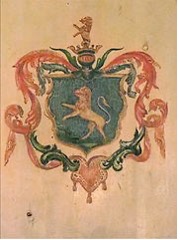
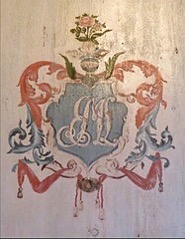
The emblems of this elite, the coats of arms, still characterize both the main church in Solum and the annex church in Mælum.
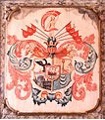
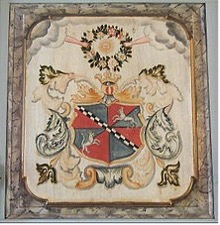
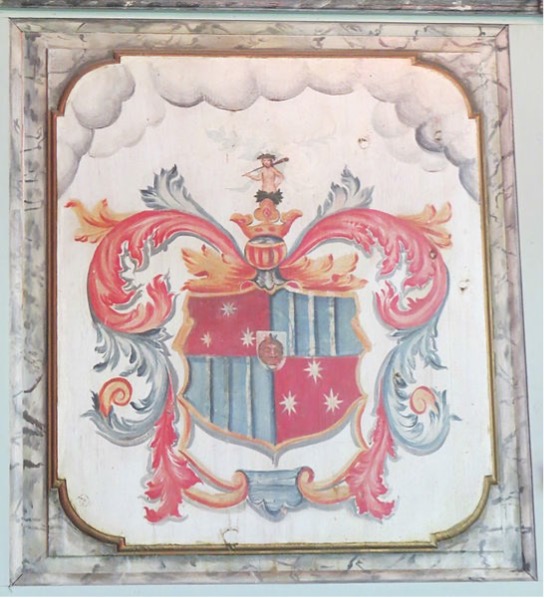

The Adeler family descended from the naval hero Cort Adeler, originally named Kurt Sivertsen and from Brevik. He went to the Netherlands as a young man and trained as a sailor. He then served in the Netherlands and Venice before becoming commander-in-chief of the Danish-Norwegian fleet. He was ennobled and was paid so well that he was able to buy large properties in Denmark and later also Gimsøy Monastery, Bratsberg and the monastery's properties in Telemark, or in short, all the property that the Dags family had managed in its time.
The first member of the Adeler family to actually come to Skien was Fredrik Georg Adeler who in 1764, at the age of just 28, became county magistrate in Bratsberg. He was the son of county magistrate in Kristiansand Frederik Adeler. On 6 October 1762, the “Highly Honored and Well-Behaved Cammerjuncker and Major” Fredrik Georg Adeler married the “Highly Honored and Well-Behaved Miss” Juliana Ernestine von Cicignon in Kristiansand Cathedral. This means that the children of the county magistrates in Kristiansand and Bergen married and county magistrate Ulrik Frederik de Cicignon in Bergen became the father-in-law of county magistrate Fredrik Georg Adeler on Gimsøy.
The wife of the county magistrate Cicignon died in 1759 and most of the children had married and moved out. After he was attacked and mistreated during the "Strile War" in 1765, Cicignon therefore sought refuge from Bergen in 1766 and lived his last years in Sønderborg on Als where he died in 1772. At least one of his unmarried daughters moved after 1766 to her sister who was married to county magistrate Adeler in Bratsberg. He was the first in the family to move to the property Gimsøy monastery in Solum which had been in the family's ownership since it was purchased by his great-grandfather, Cort Adeler. The father, county magistrate in Kristiansand, Frederik Adeler, died in 1766 and after her husband's death the widow, Anna Beate Rosenkrantz, also moved to her son at Gimsøy monastery. She brought at least two of her unmarried daughters with her to Gimsøy.
This means that large parts of the highest upper class in Norway, the relatives of the archdiocese governors Adeler in Kristiansand and Cicignon in Bergen, were gathered at Gimsøy Monastery in Solum.
Both the archdiocese governors Adeler and Cicignon belonged to the Danish-Norwegian nobility. So did their spouses. A clear expression of this is that Solum Church has the coats of arms of Adeler and his mother Anna Beate Rosenkrantz and of his spouse Juliane Ernestine's family, Brüggmann and Cicignon.
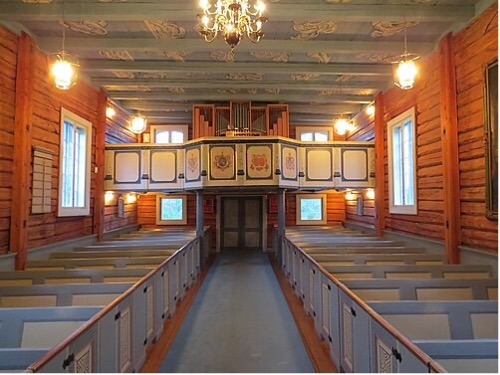
But it was not only the new main church in Solum, but also the annex church in Melum that was decorated with the coats of arms of important noble families. On the gallery front in Melum church, on the so-called Løvenskiold chair, there are painted both the family coat of arms of Løvenskiold and the alliance coats of arms of Deichmann and Rasch. They are connected to Bartholomæus Herman Løvenskiold and the parents of his wife Edel Margrethe, who was born Rasch.
Most Ibsen biographers, if they have commented on it at all, have written that the widow of skipper and merchant Henrik Petersen Ibsen in Bergen, Wenche Dishington, remarried a priest in Bergen, Jacob von der Lippe, and soon after, in 1771, he became parish priest in Solum, the neighboring parish of Skien. Her son from her first marriage, Henrik Johan Ibsen, was then only a boy of six years old and therefore accompanied her to Solum. Thus, almost by chance, a member of the Bergen Ibsen family came to Skien.
This is how, almost by chance, a member of the Bergen Ibsen family came to Skien.
No one has understood that Solum was actually a more important parish than Skien and that it was therefore a bit surprising that Jacob von der Lippe, who only had a subordinate priestly position as personnel chaplain in Nykirken in Bergen, that is, as assistant to the parish priest, could receive a calling as parish priest in such a rich and important parish as Solum.
Jacob von der Lippe descended from a merchant family that was well established in both Bergen and Stavanger, but none of his relatives had a position that could help him pursue a clerical career.
An important reason why others and more powerful people clearly wanted to help him was that few had experienced, like Jacob von der Lippe, how high the death rate was at that time for newborns and their mothers, even in the very best families.
He married for the first time in Stavanger in 1764 to Magdalene Christine Petersen von Fyhren. She was the daughter of the person who built the first lighthouse in Norway, on Kvitsøy, and who then added von Fyhren to his surname. The following year, 1765, they had a daughter who was baptized in Nykirken in Bergen as Magdalene Christine after her mother who died shortly after birth. The following year, 1766, the child also died. The same year, von der Lippe remarried in Bergen to Elisabeth Dankertsen, who was nine years younger. The following year, 1767, they had a daughter who was baptized Magdalene Christine after von der Lippe's first wife and daughter. The following year, 1768, the grandmother and their other child died in childbirth and von der Lippe was left as a second time widower with the motherless daughter Magdalene Christine.
When and where the double widower von der Lippe with a motherless daughter and the widow Wenche Ibsen née Dishington with a fatherless son married, it has not been possible to find. But in 1771 Jacob von der Lippe became parish priest in Solum – and he obviously did not get there by chance. Someone with power and authority and mutual kinship must have spoken, namely the county magistrate Cicignon in Bergen and his son-in-law, county magistrate Adeler on Gimsøy. Father-in-law Cicignon and son-in-law Adeler had both played an important role in relation to the most important community arenas and symbols in their local communities, the New Church at Nordnes in Bergen and the Solum Church. Cicignon made a great effort after the city fire in Bergen in 1756 and, among other things, had the New Church rebuilt after the fire in 1761. The year after he took office as county magistrate, Adeler had bought the Solum Church, demolished the old one and built a new one that was consecrated in 1766.
The young boy Henrik Johan Ibsen from Bergen therefore came to Solum in first grade. His mother Wenche Ibsen, who had managed through difficult years with the help of her family and the family network in Nordnes, now had a new and better opportunity in Solum to give her son Henrik Johan a good and safe upbringing. Solum therefore became the solution to all problems and gave Jacob von der Lippe and Wenche Ibsen an even better economic and social basis than they had had in Nordnes and in the Nykirken congregation.
The elite environment in Solum and the Skien area that the priest von der Lippe and his wife Wenche now entered was clearly represented by the godparents of their common child, who included the most prominent members of the Adeler family of the time, such as Chamberlain and Chamberlain Adeler and Chamberlain and County Governor Fredrik Georg Adeler.
Furthermore, there was Madame Borse who was the widow of Halvardus Severin Borse at Fjære farm in Solum. It was through the ironworks and property that Borse had collected that Herman Leopoldus and his descendants in the Løvenskiold family gained entry into Skien and the surrounding area.
Among the sponsors was court cadet Bartholomeus Herman Løvenskiold who was the owner of Borgestad farm and Bolvik ironworks in Solum and author of Description of Bradsbierg Amt and Scheens Byes with its Suburbs . His son, who was also a sponsor, was chamber cadet Jacob Løvenskiold who owned Rafnes in Bamble. Another of the sponsors was Lieutenant Colonel Deichmann at Hakasteinsfaret who was the father-in-law of chamberlain, ironworks owner and landowner Herman Løvenskiold at Fossum.