
Margrethe Frederikke Sophie Løvenskiold, the sister of Norway's governor and prime minister Severin Løvenskiold at Fosssum, was married to her Danish relative Eggert Løvenskiold.
He inherited the Holden ironworks at Ulefoss and the family moved there. Here they not only had a musical home befitting an educated upper class, but Mrs. Frederikke also composed music that the Royal Life Guard in Copenhagen performed on anniversaries for the Danish royal family.
After Eggert Løvenskiold had to liquidate the ownership of Holden Jernverk in 1829, the family moved to Denmark. Here, one of their many children, Herman Severin Løvenskiold, continued the business beyond his mother and became a full-time composer. His best-known work is the music for Bournonville's ballet La Sylphide in 1836. It was performed by the Royal Ballet in Copenhagen and was later included in the Danish cultural canon.
Holden main farm and Holden ironworks were taken over in 1835 by Knud Ibsen's cousin Didrich von Cappelen. He had also, like Eggert Løvenskiold, married a sister of the governor and prime minister Severin Løvenskiold at Fossum. Their son August Cappelen was the cousin of the composer Herman Severin Løvenskiold and the nephew of Norway's most powerful man, Severin Løvenskiold at Fossum. He was also Henrik Ibsen's third cousin. Although he had both taken his artium with the best grade and also his first exam at the University with the best grade, he went to Düsseldorf with his friend Hans Gude to study painting. He died of stomach cancer in 1852, only 25 years old, but is still considered one of our most important painters.
In Waterfall in Lower Telemark, August Cappelen shows the "engine" that for hundreds of years had driven the prosperity of Skien, the timber from Upper Telemark that could be floated down over water, through rivers and waterfalls with the help of generations upon generations of floaters, who are here represented by the lone man fighting the waterfall.
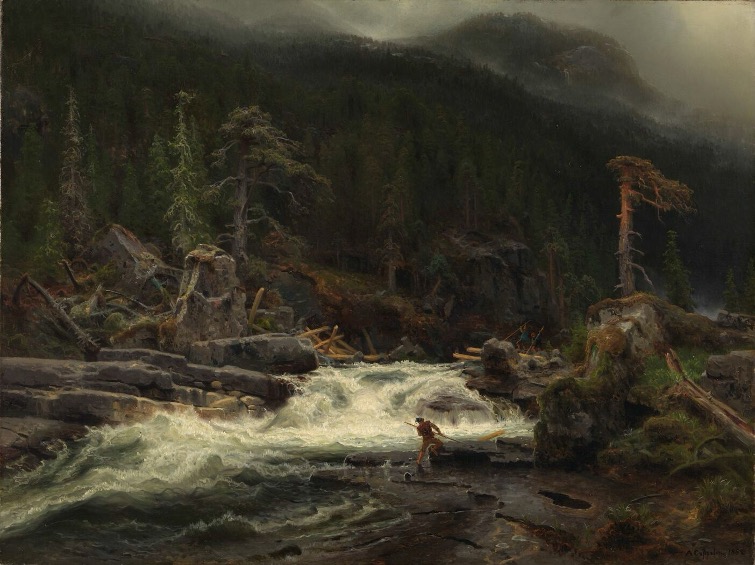
The waterfall in Lower Telemark is also a picture of an era that was over. For both the forests and the natural waterways in Telemark were losing their importance. In 1861, the first part of the Telemark Canal opened between Skien and Norsjø. It also became important for regulating the flow of water to the sawmills in Skien. But the canal was quickly outcompeted by the railway and then road transport. At the same time, the need for waterfall power, timber and charcoal fell with the transition to the coal-fired steam age and new buildings were erected in steel and concrete.

What is considered his most important work, The Dying Primeval Forest , was unfinished on the easel when August Cappelen died in Düsseldorf in 1852. It is usually interpreted as an expression of everything that is dead, rotten and dying and subject to the laws of nature about life and death. But it can also be interpreted as a symbolic expression of the dying upper class, his own patrician class which for centuries had been the lifeblood of development in Skien and Telemark.