
Therefore, not only Danes, but also prominent representatives of industry and commerce in several European countries emigrated to Norway – and not least to Skien.
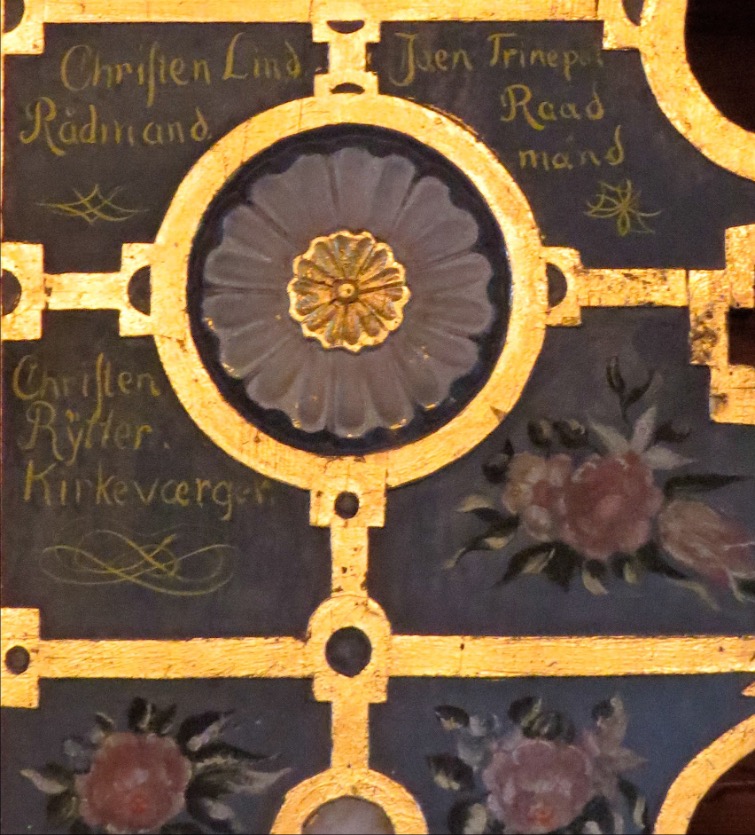
On the altarpiece in one of Skien's former churches, now in Mælum Church, it says Joen Trinepol Raadmand at the top right. After Jørgen Ansbach, he is one of the oldest ancestors in Ibsen's mother's family.
Skien was not only a meeting place for representatives of the technological development of mining in Germany, such as Jørgen Ansbach. In the 17th century, Jan or Joen Corneliussen Trinepol also came from Hoorn as a representative of the expansion in trade and shipping that is described as the "golden age" of the Netherlands. At that time, Hoorn was one of the Netherlands' most important and prosperous maritime cities and the base for the United Dutch East India Company (Vereenigde Oost-Indsche Compagnie, VOC). It was also the hometown of Willem Schouten, who in 1616 was the first to round the southern tip of South America and called it Kaap Hoorn after his birthplace. It was also to Hoorn that the later owner of Bratsberg and Gimsøy Monastery, the sea hero Cort Adeler, had traveled as a 15-year-old to learn seamanship. His descendants would again play an important role in the development of Skien and, not least, be important for the first of the Ibsen family to come to Skien.
Their sixth descendant was Henrik Ibsen.
Jan Corneliussen Trinepol's son Cornelius Jansen Trinepol succeeded his father as alderman in Skien and held this position for 40 years. He also became mayor of Skien and father of Inger Corneliusdatter Trinepol who married Povl Pedersen Paus. Their descendant in the sixth generation was Henrik Ibsen. This means that Henrik Ibsen on his mother's side descended from the closely intertwined dynasty between the mayor and alderman families of Ansbach and Trinepol in Skien which was established in the first century after the Reformation. We can follow this line through his mother's middle name Cornelia, to her grandfather "Holzførster" in Øvre Telemark, Cornelius Paus (1726-1799), and his grandfather again Cornelius Paus (1661-1732), magistrate in Øvre Telemark who was the son of Inger Trinepol, daughter of Cornelius Trinepol.
In Upper Telemark, an aristocratic social class was established during the 17th century, which in the first phase had a large degree of overlap with the city patrician families in Skien. Sons of city patricians in Skien became civil servants in Upper Telemark. Daughters of city patricians, such as Inger Trinepol, married civil servants in Upper Telemark. The reason why the sons of the city patricians established themselves as civil servants in Upper Telemark was that they could conduct financial transactions in addition to their official duties. This made it particularly attractive to be sheriffs who also engaged in lumber trade and farm trade on a large scale. Conversely, children of civil servants from Upper Telemark became citizens, sawmill owners, lumber merchants and city council members in Skien.
Throughout the 17th century, two independent aristocracies developed more and more clearly, the merchant patricians in Skien and the civil service aristocracy in Øvre Telemark. The closely intertwined family conglomerates in the merchant patriciate in Skien were constantly open to new members and new families. The civil service families that established themselves in Øvre Telemark, on the other hand, monopolized positions of power to a much greater extent. The priesthood, the office of sheriff and other civil service positions were inherited from father to son and from grandparents to grandchildren within a few family dynasties. This also applies to Henrik Ibsen's oldest ancestors in the civil service aristocracy in Øvre Telemark, the Paus family. They also married into other civil service families that later became known as citizens of Skien, such as Stockmann, Ørn and Blom.
Lårdal near Bandak is known for its unusually favorable climate. Here, two branches of the important official families in Upper Telemark gathered at the end of the 17th century and the beginning of the 18th century. The Blom family at Bjåland and Åkeren in the middle of the valley and the Paus family at Håtveit at the top of the valley.
During the 18th century, almost all members of both branches of the Blom family moved from Lårdal to Skien where they became skippers and eventually wealthy merchants. The Paus family was the opposite. It was still a dominant civil servant family in Øvre Telemark with its center of gravity in Kviteseid and a branch of the family had also become farmers in Øvre Telemark.
It is therefore not correct, as is usually done, to describe the Paus family as a rich merchant family in Skien. The only male member of the Telemark Paus family in Skien at the end of the 18th century was skipper Ole Paus from Håtveit. He had largely established his social and economic position in Skien through his relatives in the Blom family from Lårdal who were the first sons of the civil servant families in Lårdal to move back to Skien and become skippers, merchants, shipowners, lumber merchants and sawmill owners.