

"Tellemarck" is marked in white on this map from 1636 and it was under the Opslo – Oslo diocese.
After 500 BC, iron became the most important metal for making weapons and tools. For almost a thousand years, bog and sea ore was used. At Møsvasstangen north of the Hardangervidda plateau, there were large deposits of bog and sea ore, and a large number of cultural monuments have been preserved here, showing the extent of iron production that continued until the end of the 15th century.
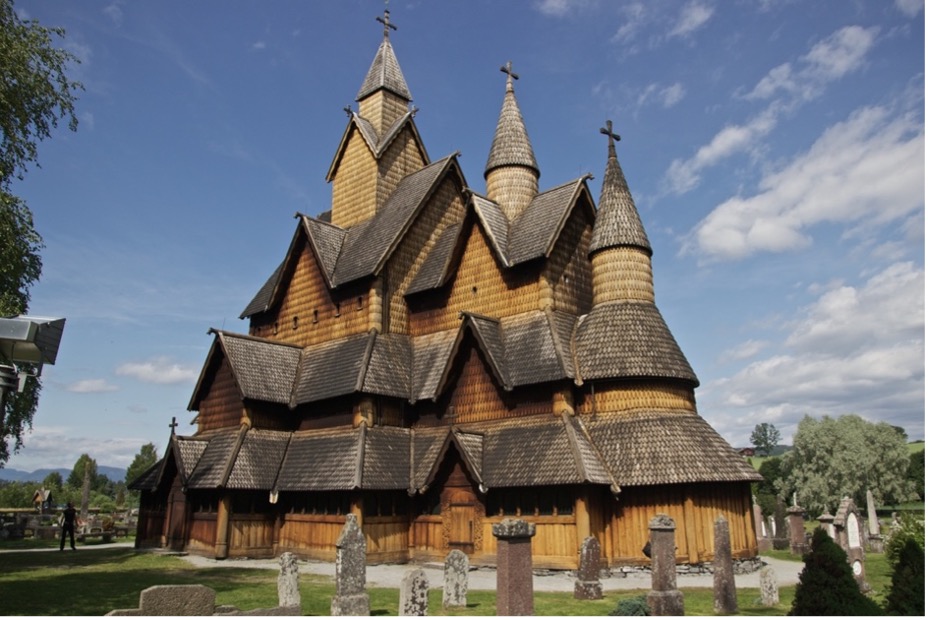
In combination with whetstones from Eidsborg, Telemark had an unbeatable combination that produced sharp axes, knives and other tools. In Telemark and the adjacent areas of Numedal and Setesdal, but also over the mountains and down into Sogn, it was possible to fell large trees early on and build houses and churches that are still standing. In particular, the many stave churches in this area have become an important part of the Norwegian world heritage.

It is no coincidence that the county coat of arms for Telemark was and has become a peasant battle axe. The reason why "Telemark" was white on the map is that Telemark was for a long time an area that was not worth visiting, and there were many stories about the belligerent peasants in Telemark who boasted about how many priests they had killed.
In the 16th century, iron and other metals began to be extracted from mines in the mountains. When silvery copper was found in Gullnes in Seljord, the king sent experts from Saxony to investigate what he hoped would become the "Thelemark Silver Mountains."
The king's sent expert, Hans Glaser, arrived in Skien in 1538 and almost immediately found large deposits, not of silver, but of iron. In 1540, the Glaser mine became the basis for Norway's first ironworks at Fossum.
The following year, Glaser returned to Norway with 100 miners from Saxony to work at the works at Gullnes and at Moisesberg in Fyresdal. He expelled the nuns from the monastery and planned for Gimsøy to become Norway's mining town and Norway's counterpart to Falun in Sweden.
Saxony was Protestant, but even though Denmark-Norway had also formally become Protestant, the farmers in Telemark still held fast to the Catholic faith and customs. Norwegian farmers were self-employed and independent. In Saxony, as in most other areas of Europe at this time, the farmers were tenants under landlords.
The independent farmers in Telemark did not accept being imposed duties and being deprived of the freedoms they had enjoyed for generations. They therefore gathered and chased the German miners back to Gimsøy. The king responded by ordering the chieftains at both the fortresses of Akershus and Båhus to put down the rebellion in Telemark. The farmers in Norway were required to have weapons in case of war. They therefore gathered fully armed in Ambjørdalen in Hjartdal where they surrounded the arriving soldiers. The farmers then received word that if they laid down their weapons, the leaders of the army would negotiate peace. They laid down their weapons. But instead of negotiations, they were surrounded by the soldiers and taken to the rectory in Hjartdal. During the trial that followed, five of the farmers were sentenced to death and another of them was sentenced to beheading. The others had to pay large fines and sign a declaration that they would henceforth be obedient subjects.

Photo: Siri Johannessen