
There have been many different stories and claims about Henrik Ibsen's puppet theatre. The local Ibsen expert Einar Østvendt said that Ibsen showed his puppet theatre in the small window to the left of the kitchen entrance. That is to say, he assumed that he was playing with glove puppets. There is nothing to suggest that. In plays with glove puppets, there is no need for an assistant, as Ibsen obviously had – and there are no strings.
All the stories about Ibsen's puppet theatre are connected to the fact that he drew figures with different facial features and beautiful costumes that he cut out of cardboard and glued onto small wooden blocks so that they could stand. He is also said to have sold some of these puppets through his mother Mæla on the market square in Skien. He used the others in his own puppet theatre, which was therefore a model theatre, that is, a cardboard model of a theatre as it was in the 19th century with rows of sets and a backdrop. In Ibsen's childhood, this was a very common toy for boys in the upper middle class in Europe. The fact that he played with model theatres was therefore a mark of his position as the eldest son in a patrician family.
As early as 1811, the first model theatres were printed and mass-produced in England. Everything indicates that Ibsen had made his model theatre himself.
What has caused confusion for most Ibsen scholars is the story that he had a trusted assistant, the skipper's son Theodor Eckstorm at Grini, and that during one of the performances it was some of the other boys, the sheriff's son Peder Lund Pedersen from Limi and Ole Paulsen from Gulset, who had cut the strings of the puppets. They immediately assumed that strings for puppets must be strings for marionettes, and therefore they have also assumed that Ibsen played with marionettes in his puppet theater.
But puppet theater is a very advanced art form where each puppet is led by a puppeteer and the puppets are large and tied to many strings so that they can move their heads, arms and legs. Leading the puppets is an art. Making them is another art.
With all due respect to Henrik Ibsen, he hardly mastered the art of puppeteering, and neither he nor his assistant Theodor Eckstorm would have been able to put on a performance with marionettes.

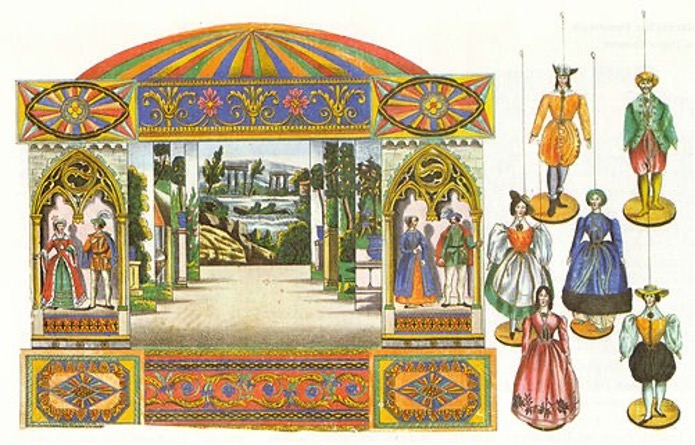
The puppet theater Henrik Ibsen had was a model theater. The puppets in the model theater stood upright on cardboard discs and could be easily moved and grouped on the stage because each puppet was attached to a string. It was therefore these strings of the puppets in Henrik Ibsen's model theater that were cut, not the strings of the marionettes.
Because he, like most people, only had two hands, he could not move more than two puppets in his model theater at a time. If he had to move larger groups of puppets, he had to have an assistant who needed no other skills than being able to move puppet figures using the strings they were attached to. This is where Theodor Eckstorm came in with his helping hands.