
On the occasion of Ibsen's 60th birthday in 1888, Henrik Jæger published what he called a "literary picture of life". Here he presented an excerpt from what Ibsen himself had written about his first childhood impressions. Almost without exception, later Ibsen biographers have taken this description as a description of what Skien was actually like in Ibsen's childhood. They were the poet's own words. Few have taken it for granted that they were the poet's words and therefore also characterized by both the poet's liberties and the poet's lack of knowledge. What is interesting is therefore not only what he says, but also what he does not say, because it shows how little he actually knew about his own background and about the town square, the town and the history of the buildings.
The first thing Ibsen reveals is that he has no idea about his grandfather and his house in Løvestredet. With increasing irritation he reacts to the fact that a street had been named after him that ran from the market square down towards the harbour or “Muddringen”. That is to say the former Løvestredet and the current Rådhusgata. Because, Ibsen stressed, “I was not born in that street and have never lived there.” That is true. But his grandfather, after whom he was named, had had house number 27 in that street and his father Knud was born there.
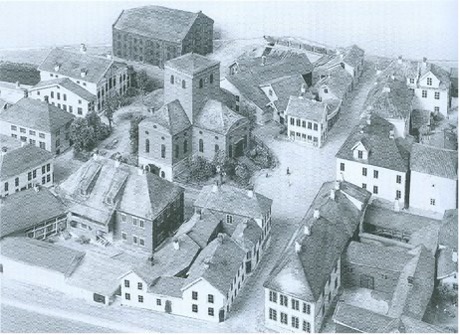
Ibsen emphasizes that he was, however, born in a farm by the square, in Stockmann's farm, which was located directly opposite the church. In the description of the square, the church was located with the high staircase in the middle. To the left was the town hall with the prison and the "fool's coffin". The fourth side of the square was the Latin school and the civic school.
The square was the natural gathering place and battlefield for the city's youth, according to Ibsen. Between the boys of the two schools, many fierce battles were fought down around the church. But because he did not belong to either school, he was mostly just present as an observer. Moreover, he adds, "in my childhood I was not at all belligerent at all."
Ibsen writes as if he had been present as an observer, but was he present at all? He was born in Stockmannsgården in 1828 – and the perspective from which he writes is Stockmannsgården. This is where he could look down into the courtyard when the nanny held him out through the window in the church tower and he heard his mother screaming. It was in Stockmannsgården that the silver coin he received at his baptism disappeared into a crack in the floor and was never found again.
But could he really remember all this?
He was only 2 years old when he moved from Stockmannsgården to Altenburggården. From here he may remember the parties and guests.
He says that he didn't go to any of the schools near the square. No, that wasn't strange. In 1835, when he was 7 years old and was about to start school, he had moved to Venstøb.
Central to Ibsen's story and to the world he describes is the church that stood free in the middle. It was the city's "most magnificent building". It was, as he writes, built by a Copenhagen builder. What he does not know or tell is that the architect was not completely insignificant. His name was Jørgen Henrik Rawert and he later became, from 1790 until his death in 1823, the head of city planning in Copenhagen.
The church looked exactly like the church in Kongsberg, Ibsen emphasized. But it was inside, not outside.

The interior of Christianskirken in Skien, which was consecrated in 1783, was modeled on the interior of the church in Kongsberg, which was consecrated in 1761. The altar, altarpiece, pulpit and organ were placed one above the other in the same way as in Nykirken in Bergen (1768) and the contemporary church in Røros (1784). The patricians were elevated above the ordinary churchgoers and had a private row with beautiful windows and white curtains facing the altar and pulpit.
What had caught his attention inside the church was the large white angel with a bowl in his hands that floated high up under the vault, but was slowly lowered down when children were to be baptized.
Ibsen goes on to say that there was a greater "attraction" in the gallows and in the town hall with all its "supposedly creepy mysteries". He describes the gallows as a reddish-brown post about a man's height and at the top it had a large round button that Ibsen perceived as a benevolent, inviting human face, slightly tilted. In front of the post hung an iron chain with an open hoop that to Ibsen looked like two small open arms that were ready to cling to his neck with "the greatest pleasure". He emphasizes that it had not been used for many years, but Ibsen claims that he remembered well that it had been standing there all the time he was in Skien, but whether it was still standing there, he did not know. The answer to the latter is obviously no. It was made of wood and would certainly have been destroyed in the city fire of 1886.
The question is whether it had even been there when Ibsen was a child – and was not just there in Ibsen's story. For in the Skien Bye Inventory for 1832 it stated:
At the entrance to the council room is a marble staircase and directly opposite a collar with accessories, moved down into the Arresten and bricked into the wall.
This means that in 1832, when Ibsen was 4 years old, there were no neck irons that were publicly visible in Skien. There is also every reason to doubt his story about the prison basement with “barred windows” facing the square where he claimed to have seen “many pale and scary faces”. Although he adds that the room at the bottom of the town hall basement “in its time” had been used to “confine the insane”, he says that this room not only had window bars like the others, but that inside the bars was a small window opening that was covered by a massive iron plate that was pierced with small holes so that it looked like a colander.
The Skien Bye Inventory for 1832 gives a slightly different description of the basement. There were not many detention cellars, but only "One Detention Room". It had two windows and there were bars in front of both windows and they were not made of iron, but of wood. In the other part of the basement there was no "Daarekiste", but instead "A Kitchen with Chimney and Bakery Oven". According to later information, a tiled stove was also installed in the detention cellar. This may be consistent with the fact that the building actually had four chimneys. In the "Laugthingstuen" itself on the main floor there was a large tiled stove on 3 floors. The town hall also did not have a sinister past, as Ibsen's story assumes, but this had been the apartment building of one of Skien's richest and most important patricians.
It is an urban space he describes. "All architecture; no green; no rural free-range landscape'. But the forces of nature that have created the prerequisites for the town of Skien are clearly heard, for "over this square space of stone and wood, the air was filled, as long as the day was, by the muffled droning rush of Langefos and Klosterfossen and from the many other falling waters".
And then he adds something he could not possibly have heard in his childhood: “through the roar of the waterfall, from morning to evening, something sounded like a sharp, sometimes shrieking, sometimes moaning woman’s cry. It was the hundreds of saw blades that were working out by the waterfalls.” Screaming saw blades are the sound of circular saws. The first circular saws in Skien were first put into use in 1845 in Chr. H. Blom’s new sawmill, where a large water wheel drove 28 saw blades. Gradually, circular saws were also installed in the other sawmills. But by then Ibsen had moved from Skien.
Jæger's comment on Ibsen's depiction of childhood, which has been uncritically passed on by most Ibsen biographers, is that everything that has been sad and heavy has had the upper hand. The seriousness of the church, the horror of the prison, the severity of the gallows and the horror of the "fool's coffin" - cast a shadow over "the childish joy of life" and awakened seriousness and early thoughtfulness.
However, Jæger also writes that the “Ibsen house” through its situation and family connections belonged to the “aristocracy” in Skien and that in Ibsen’s early childhood it was one of the centers of the city’s social life. He emphasizes that Knud Ibsen, both through his wit and his other social talents, was good at gathering people around him and was a great host who “sought his satisfaction in running a large and hospitable house”. He also refers to Ibsen’s letter to the Danish critic Georg Brandes in which Ibsen quite rightly emphasized that his parents were closely related to and belonged to Skien’s most respected families such as Plesner, vd Lippe, Cappelen and Blom or just about “all the patrician families that at that time dominated the place and the surrounding area”. This correction has been followed up to little or no extent by later Ibsen biographers, all of whom, without exception, have been concerned with describing little Henrik’s hardship and misery.
For, Jæger writes further, and here most Ibsen biographers have followed up uncritically, when Henrik Ibsen was eight years old, the “life of prosperity” came to an end. His father had to stop making payments and the only thing the family had left, when all the creditors had received theirs, “was a small, rather neglected and dilapidated country estate, the farm Venstøb, in the outskirts of the city”. Here the downtrodden family sought refuge after the catastrophe, and the life they now lived here “was distinguished by a meanness and reclusiveness that stood in stark contrast to the former splendor”. If the family had not previously noticed the social gap that existed in the small town of Skien, they now felt it all the more strongly in the days of adversity. This “has undoubtedly cast deep shadows over the small home, and next to the parents, Henrik Ibsen has naturally been the one who has felt it the most strongly”.
But was it really so?
Ibsen's story about his childhood and the square with the church in the middle is also a story about the houses of the former city patricians that had been emptied of their original function – such as Wesseltoften's former town hall, which had become a Latin school and civic school, and Blom's large farm, which had become the city's council hall. These buildings stood there as memorials to the upper class that had dominated the city of Skien, but who had now either gone bankrupt or had moved out of the city to farms in the surrounding area. It was therefore not just Knud Ibsen who had problems. Everyone had problems.
This applies not least to Knud Ibsen's childhood friend, Christopher Myhre. He ran an extensive business and was one of Skien's largest taxpayers. He was also the head of Skien's civic guard, founder and leader of the city's orchestra, bank director and Skien's first mayor. He also bought up Knud Ibsen's properties as he had to sell them, such as the distillery at Lundetangen and in 1843 also Ibsen's Venstøb. And then, in the 1850s, Christopher Myhre also had financial problems.
In 1830, Knud Ibsen was on a par with his mother-in-law Altenburg and his uncle Nicolai Plesner. They all paid 10 spd in taxes, while skipper Ole Paus only paid 2.
The basic narrative in all Ibsen biographies, that Knud Ibsen was wasteful and spent far too much – and therefore went bankrupt, is therefore completely wrong. It was the patrician class as a collective or social class that went bankrupt, not the individual Knud Ibsen.
Knud Ibsen therefore adapted to reality when they moved to the countryside, to Erlands Venstøp, which at the time was neither small, neglected nor dilapidated, but a well-kept farm with 100 acres of cultivated land with a garden where his children could grow up in good and safe surroundings.
When they moved to Erlands Venstøp, they also brought with them the social customs of the patrician class, and Henrik Ibsen, like other children of the upper class, had his own model theater at Venstøp.
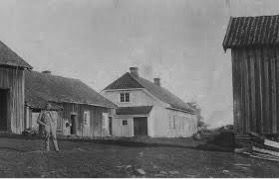
Erlands Venstøp. On the short wall of the house there was a small extension with an entrance to the kitchen. To the left of the entrance was a small room with a window and door that could be locked from the inside. Here Henrik Ibsen had his private place where he could be alone with his younger siblings. It was also here that he showed puppet shows to the children in the area.